
All About You!

Showing posts with label World. Show all posts

Thursday, 31 March 2016

Assassin’s Creed Syndicate: Check this out!!

assasins creed syndicate screenshot
Stealth being your primary tool, you are able to yet again go into the memories of heroic assassins with the use of a futuristic machine, exploring, questing, and free-running across an open map full of significant landmarks and symbols. The streets are covered with innocent citizens, angry constables, and enemy faction members that give you cause to lurk in the shadows of the crowd.
Within moments of stepping into this world, you are given the gift of a rope launcher from Alexander Graham Bell. With this you are able to explore the Assassin’s Creed logic filled city like you have before. Though it does help you get up to certain rooftops with ease, it also provides a broken logic in which you are able to do something impossible without it, and those same actions are made undoable with it. It does, however, offer the means to escape a loosing battle much more simplistically than you would without having it. Another positive aspect is the difficulty of certain mission types, whereas previous games proved it difficult to tail someone, or stealthily maneuver through enemy territory, the developers have made it a little less hair pulling in Syndicate.
assasins creed syndicate screenshot 1
With an Arkham-style combat, you will find yourself patiently clicking repetitively through attacks and counter-attacks among dozens of enemies throughout the game. Allowing for a GTA feel, hijack a horse-drawn carriage and speed down the streets of London, taking out the street dwellers as you go.
Though initially these aspects are fun and well placed for the game, they become a chore when you played a little bit. You fight against a gang that has ceased control over London, the Blighters, and you are able to dispatch members of your own gang to handle some of your dirty work. Still, come for the story, stay in one place for endless battles.
assasins creed syndicate screenshot 2
Jacob and Evie Frye are twin assassins in Syndicate, and with the ability to switch between both during the open-world missions, you are only able to perform story missions with one or the other. But there is more to them than just that. They both have their own specializations towards late gameplay. Jacob is more of a hands on player, as Evie tends to be a woman of subtle means throughout the game. Both are extremely lovable, with separate goals for most of the game. Incredibly animated, their facial expressions are on point, and will even cause you to react justly to them. You are able to craft or unlock stealthier equipment, or more lethal weapons to play strongly for their respective toolkits.
With an array of historical figures around every turn, you are able to find yourself assisting celebrities like Florence Nightingale, Charles Darwin, and Charles Dickens. The story is great unless you have been taking notes for the last 40 to 50 Creed games. There are even brief interludes that are not really meant to be understood. The missions are better than in the other games and you will be dealing with side objectives and large areas that are crawling with enemies. There are some boring side missions, though, that seem repetitive such as rescuing children from sweatshops, assassinating Templars, and bounty hunting missions.
assasins creed syndicate screenshot 3
There are a few bugs, but every game have them. You can fall into a white void, you can get stuck in scenery, and you may pinwheel until you die. It happens, but restarting does stop your progress from that moment.
The new tools and toys freshen up this game and no matter what, it is still Assassin’s Creed. The London streets are made well and eventually they become obstacles, but there are plenty of ways to get around them.

Tuesday, 29 March 2016

Get to know Why the Division by ZERO is A bad Idea. @

Vintage Mechanical Calculator Shows Why It's a Bad Idea To Divide by Zero
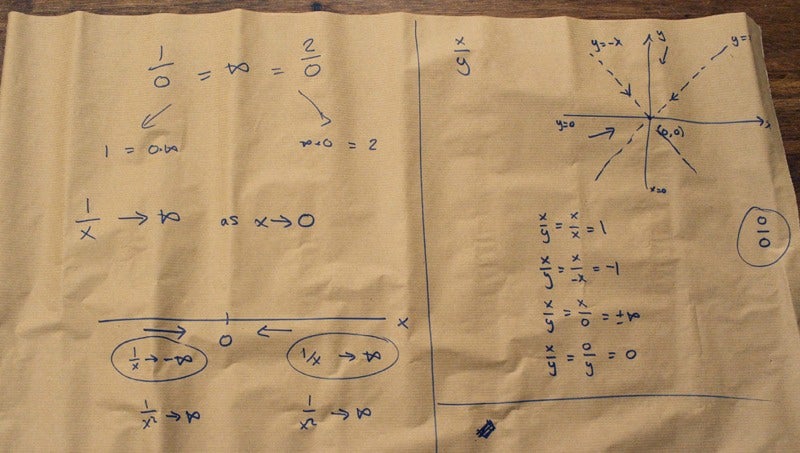
Everyone learns in grade school that you can’t divide by zero, but few of us ever learn (or fully understand) why. The stock answer is that it gives you an answer of infinity. The truth is a bit more nuanced than that, and an old mechanical calculator offers the perfect illustration.
Try to divide a number by zero with a standard calculator, and you’ll just get an error message. But check out what happens when someone tries to do this on a Facit ESA-01 mechanical calculator, with the cover helpfully removed so all the internal working are exposed:
The machine pretty much goes insane, its gears and cogs hammering away in a nonstop frenzy of clacking. WTF?
It has to do with how such machines work, and also with the nature of division—it’s basically just “glorified subtraction,” as the folks at Numberphile will tell you. To divide 20 by 4, the mechanical calculator perform a sequence of steps: 20 minus 4 is 16, 16 minus 4 is 12, 12 minus 4 is 8, 8 minus 4 is 4, and 4 minus 4 is 0. Voila! It takes five steps, so 20 divided by 4 equals 5.
But 20 divided by zero is just subtracting nothing from 20 over and over again. The calculator never arrives at an answer because it would take an infinite number of steps. And infinity is really more of a concept than an actual number.
So as Eric Limer explains over at Popular Mechanics, “The underlying cause for the freakout is that the poor machine is trying to hammer out an infinite sequence of commands, one by one. A computer will always do exactly what you tell it to do, even if that will take literally forever.”

20 Crucial Terms Every 21st Century Futurist Should Know

20 Crucial Terms Every 21st Century Futurist Should Know 

We live in an era of accelerating change, when scientific and technological advancements are arriving rapidly. As a result, we are developing a new language to describe our civilization as it evolves. Here are 20 terms and concepts that you’ll need to navigate our future.

Back in 2007 I put together a list of terms every self-respecting futurist should be familiar with. But now, some seven years later, it’s time for an update. I reached out to several futurists, asking them which terms or phrases have emerged or gained relevance since that time. These forward-looking thinkers provided me with some fascinating and provocative suggestions — some familiar to me, others completely new, and some a refinement of earlier conceptions. Here are their submissions.

1. Co-veillance

20 Crucial Terms Every 21st Century Futurist Should Know 
Futurist and scifi novelist David Brin suggested this one. It’s kind of a mash-up between Steve Mann’s sousveillance and Jamais Cascio’s Participatory Panopticon, and a furtherance of his own Transparent Society concept. Brin describes it as: “reciprocal vision and supervision, combining surveillance with aggressively effective sousveillance.” He says it’s “scrutiny from below.” As Brin told io9:
Folks are rightfully worried about surveillance powers that expand every day. Cameras grow quicker, better, smaller, more numerous and mobile at a rate much faster than Moore’s Law (i.e. Brin’s corollary). Liberals foresee Big Brother arising from an oligarchy and faceless corporations, while conservatives fret that Orwellian masters will take over from academia and faceless bureaucrats. Which fear has some validity? All of the above. While millions take Orwell’s warning seriously, the normal reflex is to whine: “Stoplooking at us!” It cannot work. But what if, instead of whining, we all looked back? Countering surveillance with aggressively effective sousveillance — or scrutiny from below? Say by having citizen-access cameras in the camera control rooms, letting us watch the watchers?
Brin says that reciprocal vision and supervision will be hard to enact and establish, but that it has one advantage over “don’t look at us” laws, namely that it actually has a chance of working. (Image credit: 24Novembers/Shutterstock)

2. Multiplex Parenting

This particular meme — suggested to me by the Institute for the Future’s Distinguished Fellow Jamais Cascio — has only recently hit the radar. “It’s in-vitro fertilization,” he says, “but with a germline-genetic mod twist.” Recently sanctioned by the UK, this is the biotechnological advance where a baby can have three genetic parents via sperm, egg, and (separately) mitochondria. It’s meant as a way to flush-out debilitating genetic diseases. But it could also be used for the practice of human trait selection, or so-called “designer babies”. The procedure is currently being reviewed for use in the United States. The era of multiplex parents has all but arrived.

3. Technological Unemployment

20 Crucial Terms Every 21st Century Futurist Should Know 
Futurist and scifi novelist Ramez Naam says we should be aware of the potential for “technological unemployment.” He describes it as unemployment created by the deployment of technology that can replace human labor. As he told io9,
For example, the potential unemployment of taxi drivers, truck drivers, and so on created by self-driving cars. The phenomenon is an old one, dating back for centuries, and spurred the original Luddite movement, as Ned Ludd is said to have destroyed knitting frames for fear that they would replace human weavers. Technological unemployment in the past has been clearly outpaced (in the long term) by the creation of new wealth from automation and the opening of new job niches for humans, higher in levels of abstraction. The question in the modern age is whether the higher-than-ever speed of such displacement of humans can be matched by the pace of humans developing new skills, and/or by changes in social systems to spread the wealth created.
Indeed, the potential for robotics and AI to replace workers of all stripes is significant, leading to worries of massive rates of unemployment and subsequent social upheaval. These concerns have given rise to another must-know term that could serve as a potential antidote: guaranteed minimum income. (Image credit: Ociacia/Shutterstock)

4. Substrate-Autonomous Person

20 Crucial Terms Every 21st Century Futurist Should Know 
 In the future, people won’t be confined to their meatspace bodies. This is what futurist and transhumanist Natasha Vita-More describes as the “Substrate-Autonomous Person.” Eventually, she says, people will be able to form identities in numerous substrates, such as using a “platform diverse body” (a future body that is wearable/usable in the physical/material world — but also exists in computational environments and virtual systems) to route their identity across the biosphere, cybersphere, and virtual environments.
“This person would form identities,” she told me. “But they would consider their personhood, or sense of identity, to be associated with the environment rather than one exclusive body.” Depending on the platform, the substrate-autonomous person would upload and download into a form or shape (body) that conforms to the environment. So, for a biospheric environment, the person would use a biological body, for the Metaverse, a person would use an avatar, and for virtual reality, the person would use a digital form.

5. Intelligence Explosion

20 Crucial Terms Every 21st Century Futurist Should Know 
It’s time to retire the term ‘Technological Singularity.’ The reason, says the Future of Humanity Institute’s Stuart Armstrong, is that it has accumulated far too much baggage, including quasi-religious connotations. It’s not a good description of what might happen when artificial intelligence matches and then exceeds human capacities, he says. What’s more, different people interpret it differently, and it only describes a limited aspect of much broader concept. In its place, Armstrong says we should use a term devised by the computer scientist I. J. Good back in 1967: the “Intelligence explosion.”
It describes the apparent sudden increase in the intelligence of an artificial system such as an AI. There are several scenarios for this: it could be that the system radically self improves itself, finding that as it becomes more intelligent, it’s easier for it to become more intelligent still. But it could also be that human intelligence clusters pretty close in mindspace, so a slowly improving AI could shoot rapidly across the distance that separates the village idiot from Einstein. Or it could just be that there are strong skill returns to intelligence, so that an entity need only be slightly more intelligent that humans to become vastly more powerful. In all cases, the fate of life on Earth is likely to be shaped mainly by such “super-intelligences”.

6. Longevity Dividend

While many futurists extol radical life extension on humanitarian grounds, few consider the astounding fiscal benefits that are to be had through the advent of anti-aging biotechnologies. The Longevity Dividend, as suggested to me by bioethicist James Hughes of the IEET, is the “assertion by biogerontologists that the savings to society of extending healthy life expectancy with therapies that slow the aging process would far exceed the cost of developing and providing them, or of providing additional years of old age assistance.” Longer healthy life expectancy would reduce medical and nursing expenditures, argues Hughes, while allowing more seniors to remain independent and in the labor force. No doubt, the corporate race to prolong life is heating up in recognition of the tremendous amounts of money to be made — and saved — through preventative medicines.

7. Repressive Desublimation

This concept was suggested by our very own Annalee Newitz, editor-in-chief of io9 and author of Scatter, Adapt And Remember. The idea of repressive desublimation was first developed by by political philosopher Herbert Marcuse in his groundbreaking book Eros and Civilization. Newitz says:
It refers to the kind of soft authoritarianism preferred by wealthy, consumer culture societies that want to repress political dissent. In such societies, pop culture encourages people to desublimate or express their desires, whether those are for sex, drugs or violent video games. At the same time, they’re discouraged from questioning corporate and government authorities. As a result, people feel as if they live in a free society even though they may be under constant surveillance and forced to work at mind-numbing jobs. Basically, consumerism and so-called liberal values distract people from social repression.

8. Intelligence Amplification

20 Crucial Terms Every 21st Century Futurist Should Know
Sometimes referred to as IA, this is a specific subset of human enhancement — the augmentation of human intellectual capabilities via technology. “It is often positioned as either a complement to or a competitor to the creation of Artificial Intelligence,” says Ramez Naam. “In reality there is no mutual exclusion between these technologies.” Interestingly, Naam says IA could be a partial solution to the problem of technological unemployment — as a way for humans, or posthumans, to “keep up” with advancing AI and to stay in the loop.

9. Effective Altruism

This is another term suggested by Stuart Armstrong. He describes it as
the application of cost-effectiveness to charity and other altruistic pursuits. Just as some engineering approaches can be thousands of times more effective at solving problems than others, some charities are thousands of time more effective than others, and some altruistic career paths are thousands of times more effective than others. And increased efficiency translates into many more lives saved, many more people given better outcomes and opportunities throughout the world. It is argued that when charity can be made more effective in this way, it is a moral duty to do so: inefficiency is akin to letting people die.

10. Moral Enhancement

On a somewhat related note, James Hughes says moral enhancement is another must-know term for futurists of the 21st Century. Also known as virtue engineering, it’s the use of drugs and wearable or implanted devices to enhance self-control, empathy, fairness, mindfulness, intelligence and spiritual experiences.

11. Proactionary Principle

This one comes via Max More, president and CEO of the Alcor Life Extension Foundation. It’s an interesting and obverse take on the precautionary principle. “Our freedom to innovate technologically is highly valuable — even critical — to humanity,” . “This implies several imperatives when restrictive measures are proposed: Assess risks and opportunities according to available science, not popular perception. Account for both the costs of the restrictions themselves, and those of opportunities foregone. Favor measures that are proportionate to the probability and magnitude of impacts, and that have a high expectation value. Protect people’s freedom to experiment, innovate, and progress.”

12. Mules

Jamais Cascio suggested this term, though he admits it’s not widely used. Mules are unexpected events — a parallel to Black Swans — that aren’t just outside of our knowledge, but outside of our understanding of how the world works. It’s named after Asimov’s Mule from the Foundation series.

13. Anthropocene

20 Crucial Terms Every 21st Century Futurist Should Know
Another must-know term submitted by Cascio, described as “the current geologic age, characterized by substantial alterations of ecosystems through human activity.” (Image credit: NASA/NOAA).

14. Eroom’s Law

Unlike Moore’s Law, where things are speeding up, Eroom’s Law describes — at least in the pharmaceutical industry — things that are slowing down (which is why it’s Moore’s Law spelled backwards). Ramez Naam says the rate of new drugs developed per dollar spent by the industry has dropped by roughly a factor of 100 over the last 60 years. “Many reasons are proposed for this, including over-regulation, the plucking of low-hanging fruit, diminishing returns of understanding more and more complex systems, and so on,” he told io9.

15. Evolvability Risk

Natasha Vita-More describes this as the ability of a species to produce variants more apt or powerful than those currently existing within a species:
One way of looking at evolvability is to consider any system — a society or culture, for example, that has evolvable characteristics. Incidentally, it seems that today’s culture is more emergent and mutable than physiological changes occurring in human biology. In the course of a few thousand years, human tools, language, and culture have evolved manifold. The use of tools within a culture has been shaped by the culture and shows observable evolvability-from stones to computers-while human physiology has remained nearly the same.

16. Artificial Wombs

“This is any device, whether biological or technological, that allows humans to reproduce without using a woman’s uterus,” says Annalee Newitz. Sometimes called a “uterine replicator,” she says these devices would liberate women from the biological difficulties of pregnancy, and free the very act of reproduction from traditional male-female pairings. “Artificial wombs might develop alongside social structures that support families with more than two parents, as well as gay marriage,” says Newitz.

17. Whole Brain Emulations

Whole brain emulations, says Stuart Armstrong, are human brains that have been copied into a computer, and that are then run according to the laws of physics, aiming to reproduce the behaviour of human minds within a digital form.
They are dependent on certain (mild) assumptions on how the brain works, and requires certain enabling technologies, such as scanning devices to make the original brain model, good understanding of biochemistry to run it properly, and sufficiently powerful computers to run it in the first place. There are plausible technology paths that could allow such emulations around 2070 or so, with some large uncertainties. If such emulations are developed, they would revolutionise health, society and economics. For instance, allowing people to survive in digital form, and creating the possibility of “copyable human capital”: skilled, trained and effective workers that can be copied as needed to serve any business purpose.
Armstrong says this also raises great concern over wages, and over the eventual deletion of such copies.

18. Weak AI

Ramez Naam says this term has gone somewhat out of favor, but it’s still a very important one. It refers to the vast majority of all ‘artificial intelligence’ work that produces useful pattern matching or information processing capabilities, but with no bearing on creating a self-aware sentient being. “Google Search, IBM’s Watson, self-driving cars, autonomous drones, face recognition, some medical diagnostics, and algorithmic stock market traders are all examples of ‘weak AI’,” says Naam. “The large majority of all commercial and research work in AI, machine learning, and related fields is in ‘weak AI’.”

19. Neural Coupling

Imagine the fantastic prospect of creating interfaces that connect the brains of two (or more) humans. Already today, scientists have created interfaces that allow humans to move the limb — or in this case, the tail — of another animal. At first, these technologies will be used for therapeutic purposes; they could be used to help people relearn how to use previously paralyzed limbs. More radically, it could eventually be used for recreational purposes. Humans could voluntarily couple themselves and move each other’s body parts.

20. Computational Overhang

This refers to any situation in which new algorithms can suddenly and dramatically exploit existing computational power far more efficiently than before. This is likely to happen when tons of computational power remains untapped, and when previously used algorithms were suboptimal. This is an important concept as far as the development of AGI (artificial general intelligence) is concerned. As noted by Less Wrong, it
signifies a situation where it becomes possible to create AGIs that can be run using only a small fraction of the easily available hardware resources. This could lead to an intelligence explosion, or to a massive increase in the number of AGIs, as they could be easily copied to run on countless computers. This could make AGIs much more powerful than before, and present an existential risk.
Luke Muehlhauser from the Machine Intelligence Research Institute (MIRI) describes it this way:
Suppose that computing power continues to double according to Moore’s law, but figuring out the algorithms for human-like general intelligence proves to be fiendishly difficult. When the software for general intelligence is finally realized, there could exist a ‘computing overhang’: tremendous amounts of cheap computing power available to run [AIs]. AIs could be copied across the hardware base, causing the AI population to quickly surpass the human population.

The disturbing fact of the resurrection:

By Bishop Robert Barro
The disturbing fact of the resurrection
The resurrection of Jesus from the dead is the be-all and the end-all of the Christian faith. If Jesus didn’t rise from the dead, all bishops, priests, and Christian ministers should go home and get honest jobs, and all the Christian faithful should leave their churches immediately. As Paul himself put it: “If Jesus is not raised from the dead, our preaching is in vain and we are the most pitiable of men.” It’s no good, of course, trying to explain the resurrection away or rationalize it as a myth, a symbol, or an inner subjective experience. None of that does justice to the novelty and sheer strangeness of the Biblical message. It comes down finally to this: if Jesus was not raised from death, Christianity is a fraud and a joke; if he did rise from death, then Christianity is the fullness of God’s revelation, and Jesus must be the absolute center of our lives. There is no third option. I want to explore, very briefly, a handful of lessons that follow from the disquieting fact of the Resurrection. First, this world is not it. What I mean is that this world is not all that there is. We live our lives with the reasonable assumption that the natural world as we’ve come to know it through the sciences and discern it through common sense is the final framework of our lives and activities. Everything (quite literally, everything) takes place within the theater of our ordinary experience. And one of the most powerful and frightening features of the common-sense world is death. Every living thing dies and stays dead. Indeed, everything in the universe, scientists tell us, comes into being and then fades away permanently.
But what if this is not in fact the case? What if the laws of nature are not as iron-clad as we thought? What if death and dissolution did not have the final say? What if, through God’s power and according to his providence, a “new heavens and a new earth” were being born? The resurrection of Jesus from the dead shows as definitively as possible that God is up to something greater than we had imagined or thought possible. And therefore we don’t have to live as though death were our master and as though nihilism were the only coherent point of view. After he had encountered the risen Christ, Paul could even taunt death: “Where is your sting?” In light of the resurrection, we can, in fact, begin to see this world as a place of gestation, growth and maturation toward something higher, more permanent, more splendid.
Here’s a second lesson derived from the resurrection: the tyrants know that their time is up. Remember that the cross was Rome’s way of asserting its authority. Roman authorities declared that if you run afoul of our system, we will torture you to death in the most excruciating (ex cruce, from the cross) way possible and then we will leave your body to waste away be devoured by the beasts of the field. The threat of violence is how tyrants up and down the centuries have always asserted their authority. Might makes right. The crucified Jesus appeared to anyone who was witnessing the awful events on Calvary to be one more affirmation of this principle: Caesar always wins in the end. But when Jesus was raised from the dead through the power of the Holy Spirit, the first Christians knew that Caesar’s days were numbered. Jesus had taken the worst that the world could throw at him and he returned, alive and triumphant. They knew that the Lord of the world was no longer Caesar, but rather someone whom Caesar had killed but whom God had raised from death. This is why the risen Christ has been the inspiration for resistance movements up and down the centuries. In our own time we saw how deftly John Paul II wielded the power of the cross in Communist Poland. Though he had no nuclear weapons or tanks or mighty armies, John Paul had the power of the resurrection, and that proved strong enough to bring down one of the most imposing empires in the history of the world. Once again, the faculty lounge interpretation of resurrection as a subjective event or a mere symbol is exactly what the tyrants of the world want, for it poses no real threat to them.
The third great lesson of the resurrection is that the path of salvation has been opened to everyone. Paul told us that “though he was in the form of God, Jesus did not deem equality with God something to be grasped. Rather he emptied himself and took the form of slave…accepting even death, death on a cross.” In a word, Jesus went all the way down, journeying into pain, despair, alienation, even godforsakenness. He went as far as you can go away from the Father. Why? In order to reach all of those who had wandered from God. Then, in light of the resurrection, the first Christians came to know that, even as we run as fast as we can away from the Father, all the way to godforsakenness, we are running into the arms of the Son. The opening up of the divine life allows everyone free access to the divine mercy. And this is why the Lord himself could say, “When the Son of Man is lifted up, he will draw all people to himself,” and why Paul could assert in 1 Corinthians, “When everything is subjected to him, then the Son himself will also be subjected to the one who subjected everything to him, so that God may be all in all.” The resurrection shows that Christ can gather back to the Father everyone whom he has embraced through his suffering love.
So on Easter Sunday, let us not domesticate the still stunning and disturbing message of resurrection. Rather, let us allow it to unnerve us, change us, set us on fire.

Oculus Rift Review: VIRTUAL REALITY!!

Oculus Rift Review: This Shit Is Legit 
This has been the promise of Oculus all along: a truly immersive virtual reality experience. From the beginning, when Oculus was first introduced as a Kickstarter, the nerds were already on board—legions of gamers and early adopters were ready to buy into virtual reality before they even saw it themselves. For the rest of us, VR has remained an elusive and tedious source of hype. It’s all talk about the future and the possibilities that lie ahead, but for the most part, it’s been a future we can’t see. And when virtual reality doesn’t fill a need, the way a smartphone does by putting the internet in your pocket, the technology is hard to get excited about.
Even if you’ve had a glimpse of VR’s “promise”—with Google Cardboard, Samsung Gear VR, or an early Oculus development kit—and were wowed in the moment, it was probably more excitement about what it could become, rather than what it was.
Oculus Rift Review: This Shit Is Legit
 
The Oculus sensor tracks the motion of your head very accurately, making the illusion of virtual reality complete.
Because the best content on the best VR viewers until now has sucked. Oculus’ first two headsets were uncomfortable and cumbersome; the image quality has never been realistic enough to transport you to another world entirely; and worst of all, the screens inside the headsets can’t keep up with head movement fast enough to keep people from getting sick.
But now we have the Rift—the final version. A finished consumer product that delivers a polished experience that can be appreciated not just by the nerds.

Preparing to go virtual

Oculus Rift Review: This Shit Is Legit
 
Despite a valiant effort to make VR dead simple, Oculus Rift is still hardly super simple.
The moment you pull the Rift’s retail package from its brown shipping carton, you can tell it’s a different device this time around. A white glossy sleeve encloses a dramatic black box that flips open like a flight case. Everything is nestled into a molded spot, and a sticker on the inside-top flap invites you to a setup website, from which you’re guided step by step through the installation.
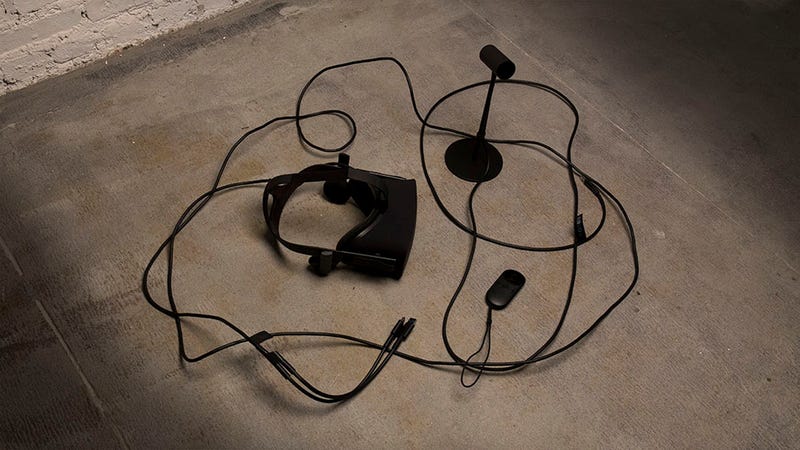
Oculus has gone to pains to mimic the experience of famously simple consumer products (ahem, Apple) right from the start. It’s a valiant effort for a lumbering headset you’ll eventually have to strap to your face, and make no mistake—this process is hardly simple. There’s a lot of stuff in this box:
  • The headset with its tether cable that connects to your computer
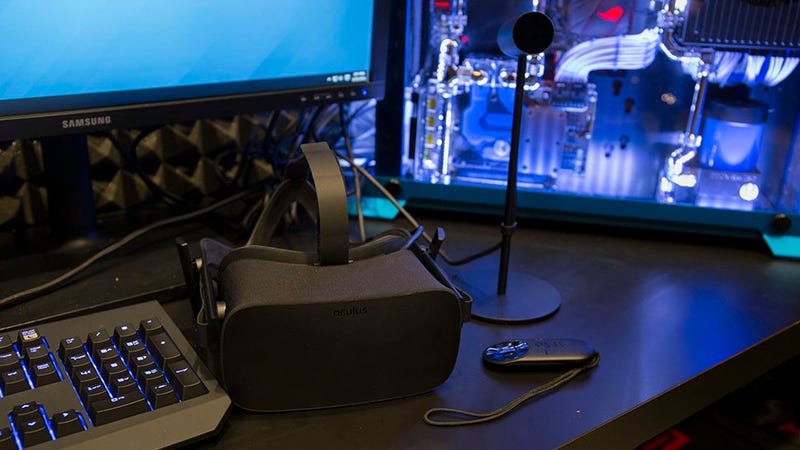
  • The Oculus sensor and stand, which track the position of the Rift on your head.
  • The compact Oculus remote, which allows you to navigate menus and adjust the volume while you’re wearing the headset.
  • An Xbox One controller for playing games, and the USB adapter that wirelessly connects the controller to your computer. (At launch, Oculus’ motion tracking Touch controllers won’t be available. According to the company, they’ll be out later this year.)
And that’s not really all of it, unless you already have a sick gaming computer. Along with our review unit, Oculus sent us one of its Oculus-ready PCs: a $950 Asus tower with a Nvidia Geforce GTX 970 graphics card, which costs more than $300 on its own, and a chassis bedazzled with customizable glowing LEDs that make the thing look like some mysteriously powerful chunk of alien spaceship.
Oculus Rift Review: This Shit Is Legit
 
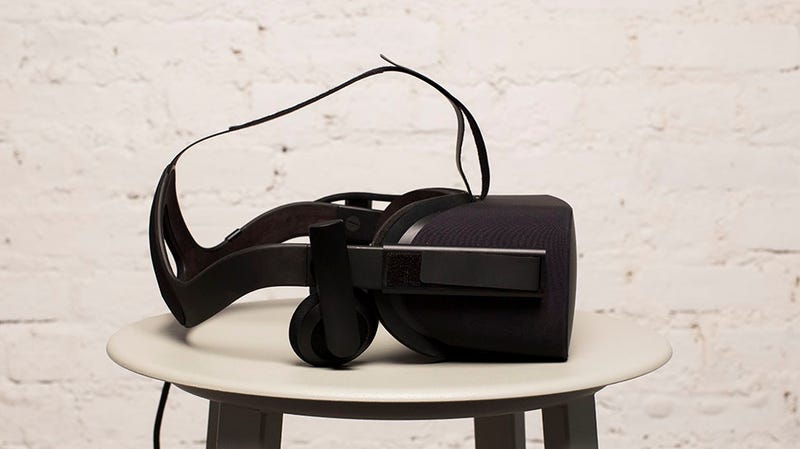
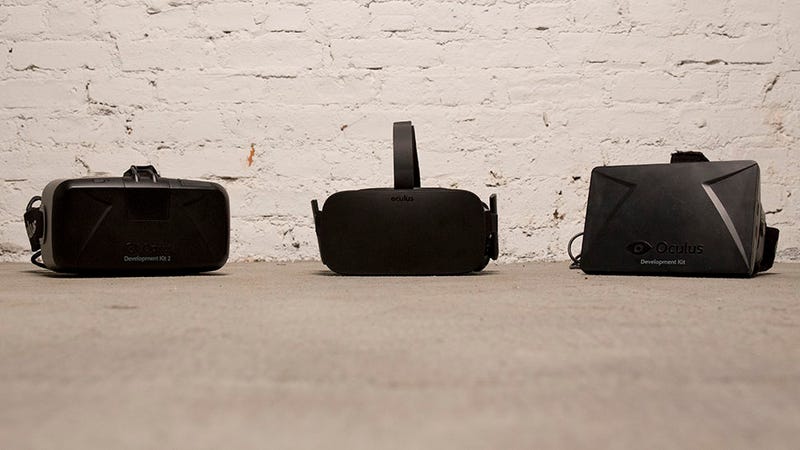
Oculus has done a beautiful job refining the design of the Rift to the point that it’s a convincing consumer electronic device.
After about an hour of unboxing and plugging in a gazillion cables, you’re ready to actually start setting up the software, which takes another 20 minutes to download. From there, the step-by-step installation is a breeze, and requires zero technical know-how. It’s hardly as easy as plugging in a new MacBook, but having had the displeasure of assembling and installing Oculus development kits, I can tell you that this new process is nothing short of revelatory.
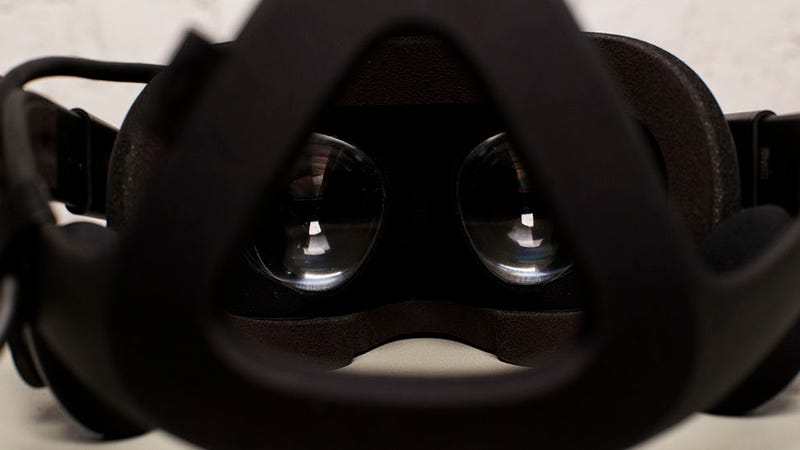
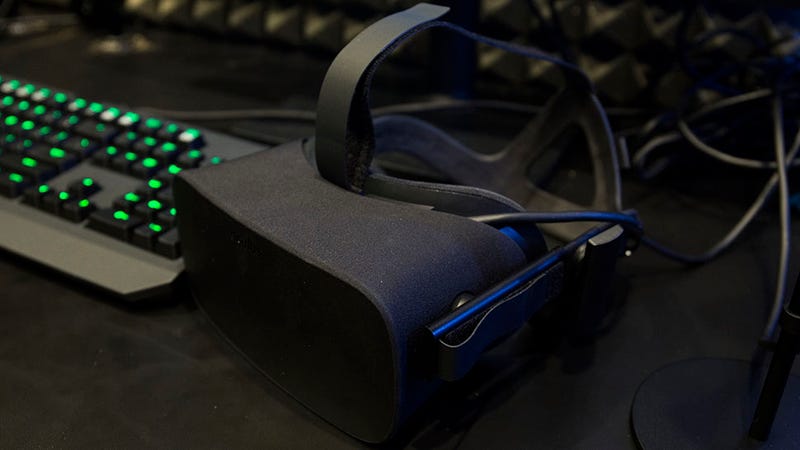
The new Oculus headset looks like an all-black pair of ski goggles with sturdy straps to affix it to your head. Holding it in both hands, it feels like about the weight of a pound of ground coffee. Inside are two modestly adjustable lenses, which are your portholes to the OLED display. The headset has integrated on-ear speakers, which rest comfortably on your head and remove the need for additional cords latching you to your PC. There’s only one bundle of cords snaking out from the headset, and with the exception of that pesky primary tether, which every so often catches a snag and pulls you out of your virtually transported state, Oculus has succeeded in making something that looks and feels like a premium consumer electronic device.

This ain’t your dad’s VR

Oculus Rift Review: This Shit Is Legit
 
Enter the void
I’ve never understood Oculus’ insistence that you need to be standing to use the Rift. Until more movement-oriented experiences exist—and the Touch motion controllers are available—sitting in a swivel chair allows more than a sufficient range of movement. Although it’s weird to see how far you’ve rolled away from a desk when you emerge from the void beyond.
Once you’ve put the thing on your head, you’re presented with a simple UI, called Oculus Home, which allows you to browse apps in your library and the Oculus store, where you can download more. Many of the apps are huge, and on crowded broadband, I was more likely to leave them downloading overnight than sit at the computer twiddling my thumbs.
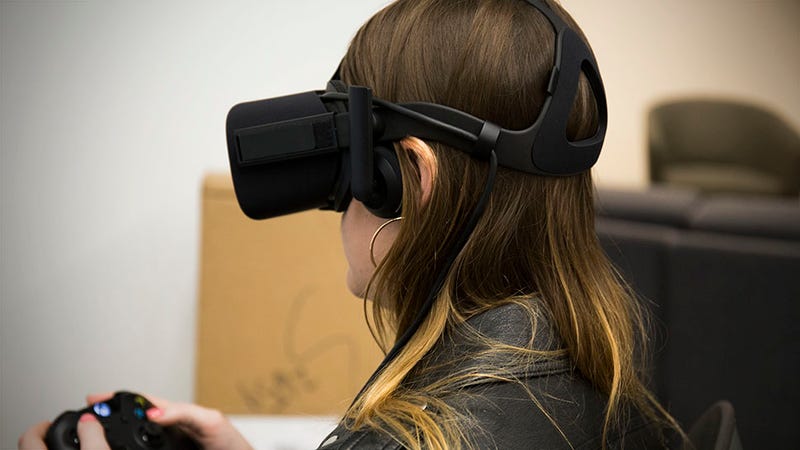
In virtual reality, moving your head changes the perspective of the image you’re viewing, as if it was actually in front of you. You interact with the virtual world using a manual input device, like an Xbox One controller or the Oculus remote. To navigate the UI, you simply point your head at what you want to interact with, and click on it with your controller. The movement is smooth, and pointing your head at something inside the Rift is basically identical to turning your head in real life. Just make sure you know where the controller is when you put the headset on, or you’ll have an unpleasant moment blindly fumbling around for it.
Oculus Rift Review: This Shit Is Legit
 
Oculus has mastered the design of the Rift such that it’s comfortable to wear for long periods of time. It still looks a little goofy though.
The available apps hint at the potential for the Rift beyond gaming, but they’re not ready for prime time. Oculus Video, for example, allows you to view 360 and 2D content through the headset. (It includes a mandatory subcategory for 360 videos on Facebook, which now owns Oculus.) When watching movies in “lean back” mode, I find myself much more aware of the headset then when I’m playing games. It’s really no better than watching a movie in a darkened room. There are other experimental apps, like a VR tour of the human body, but they’re not that interesting. It’s all more future than now.

All fun and games

Oculus Rift Review: This Shit Is Legit 
The Rift was really designed as a gaming device, and this is where it shines. After sampling a few titles, it’s clear that the simpler the controls for a game, the more enjoyable and immersive I found the experience. I had the most fun playing the whimsical and childishly simple Lucky’s Tale, in which you play a cartoon fox hopping along in the world, racking up points, evading enemies, and completing challenges.
People in the office who had less gaming experience found Lucky’s Tale immediately intuitive too, and it shows how a VR headset can actually simplify gaming and make it more accessible. Most traditional 360 games (think Call of Duty or other first-person shooters) require two kinds of directional inputs (joystick or arrows on a controller)—one of them controls “the camera” or the way you’re facing, and the other controls your directional movement. Combining them seamlessly requires a fair amount of coordination, but a VR headset takes care of the camera view, which makes it a lot easier. Gunjack, the arcade shooter, is easy to master because you point your head in the direction of vessels you need to shoot out of the sky. It’s fun and super satisfying, without a huge learning curve.
On the opposite end of the spectrum is Eve: Valkyrie, a space simulator spin off of Eve Online, which is probably the type of title hardcore gamers are looking for. Since I’m not one of these gamers, the controls for piloting the spaceship were tough for me. I found myself getting sick after about five minutes, and the missions were so stressful and intense that I threw off my headset. It’s not surprising that making a realistic and enjoyable spaceship simulator would be difficult, and I did get better over the week. But I’m still not hurting to play the game.

The failings of the future

Oculus Rift Review: This Shit Is Legit 
I’m not saying it would be impossible for me to adjust to Eve: Valkyrie eventually, but a period of adjustment is exactly what Oculus is trying to eliminate. The company has worked for four years to make a product accessible enough for anybody. This title, and others like it, are going to fall painfully short of the mainstream accessibility Oculus wants to achieve in the long run—no matter how much the technology improves.
While we’re on flaws, I’ll add a few more. There are still moments when you see hints of “screen-door effect”—wherein the space between pixels is visible, because the OLED displays are almost on top of of your eyeballs. The effect is akin to seeing the world through a screened-in porch. Plus the image is occasionally blurry, and the sweet spot for the lenses feels elusive and small. At times, it’s like you’re staring through a tunnel at the image, insofar as the edges of your field-of-view look artificially cut off.
Then there’s the price. The Rift package alone costs $600. Add the $950 PC we used, and you’re looking at a total of $1550. It’s a shitload of money, and probably enough to mean Oculus will remain mostly niche. In other words, even if Oculus made a device that’s accessible to all, it’s still pretty much only for gamers. If you’re one of those people who is ready to drop that kind of coin, you should wait for next week’s reviews of the HTC Vive, which has a headset with similar specifications to the Rift.
What Oculus has accomplished is remarkable. There’s plenty that even the completely uninitiated user can enjoy. More importantly, the Rift is truly immersive in most cases. The image quality is mostly excellent, and the head-tracking is nearly flawless. Indeed, perhaps what’s most significant is that there are moments when I can say unreservedly and without caveats that I am enjoying the Rift right in the moment—not as a device indicative of some desirable future, but as a device to own right now. I still can’t afford the future of virtual reality, but for the first time, I actually want to.

README

  • Oculus Rift is fun. Seriously, man, playing games is fun.
  • The Rift is miraculously easy to install and use.
  • The experience is wholly immersive, and doesn’t make you want to vomit (most of the time).
  • More complex and disorienting games will still turn your stomach.
  • The Rift is mostly good for games right now—everything else is bogus.

Daisy Ridley's Force Awakens Audition Was Intense As Hell

Daisy Ridley's Force Awakens Audition Was Intense As Hell
 
The Force Awakens had lots of lovely surprises—but one of the biggest of all was just how relative newcomer Daisy Ridley completed nailed her portrayal of Rey. Now that we’ve seen her audition though, it’s hard not to see why the production team fell in love with her, too.
This short clip from a documentary included on The Force Awakens’ home release discusses Rey’s creation, and how Ridley came to be attached to the project—but it also includes a snippet of footage from one of her audition tapes. Check it out:

Ridley’s audition scene (or at least one of them) ended up being part of the interrogation sequence between Rey and Kylo Ren after Rey was captured on Takodana in the movie... and man. It’s certainly impressive, but almost a little uncomfortable to watch her struggle and cry outside the context of the movie. And she had to do it again and again!
It is pretty cool to see all this behind-the-scenes footage though, given all the secrecy around The Force Awakens during its production. You can see even more of it when the movie releases on Blu-Ray and DVD next week, on April 5th.

Monday, 28 March 2016

3 Top Ways People Get Infected by An Email Virus. UPDATES!


Email virus going via network
Viruses were more than likely already evolving when the population started on this planet. Since the invention of computer technology, programmers have upped their wits about biological viruses and found a way to transform that into something useful with the computer, and it came in the way of tiny programs.
A virus’s purpose is to spread itself and continue to multiply. A consequence of this is the damage it can do to the host. Entering through an email is the most common way to catch a virus.
Everyone should have some knowledge about how emails can get infected by a virus, and always stay alert of them. In this article you will learn about the three most common ways people get infected by a virus through emails. You will also be shown how to avoid getting the viruses into your computer.

The first way of getting an email virus is receiving an email hoax

email virus example 1
To start out, you should understand that a virus is merely a program invented to commit sabotage. Of course, that isn’t the case in all instances, some of them concentrate on a person’s naivety.
An email can get a virus through chain letters, or something that is asking you help with donations, or virus warnings. These can all fall under email hoax.
The email itself can also be a virus. This type of virus can clog up your mail servers and/or email inbox. The damage from an email virus can cause you a lot of pain in the way of wasting your time, messing with your resources, and of course, your energy.
Anytime you receive an email that has the possibility of being a hoax you should not forward it to anyone else. The only time you should forward an email is when you are positive that it is a genuine email, and not a hoax.
There are lists of the latest top 10 viruses, top 10 virus hoaxes, and top 10 virus alerts. They can all be found at About.com, if you want a good resource that will keep you informed about email hoaxes.
At Hoax-Slayer.com you will eventually be able to verify the credibility of any email you receive. In the meantime, if you have received an email that you feel may have been trying to steal information from you, or defraud you in any way, you should report it.

Email attachments can carry viruses too

email virus example 3
Getting an infection with a computer virus, such as a self replicating program, can be a lot more critical than forwarding an email with a virus, which doesn’t cause much damage, but they can forward themselves to all of your contacts.
However, there are email viruses that can be pre-programmed to look for certain files on your computer’s system and destroy them. Most of these viruses are going to be through email attachments.
Email attachments containing viruses will be in the form of one of the following:
Executable program file: exe, .com, .zip, .vbs, .scr, .pif, .dll, and .js.
Macro virus file: .doc, .dot, .xis, .xlt.
To avoid coming across an email with a virus, simply do not open any attachments that may come with it. However, you can open your word documents in Open Office or WordPad, and there are other programs that don’t support macros.

There are many viruses that will add two file extensions in order to try and hide the fact of their true nature, similar to the viruses referred to as the ILOVEYOU virus. The file containing it was actually named “LOVE-LETTER-FOR-YOU.TXT.vbs.”
Just keep in mind that when you read a standard email, it isn’t going to do any damage, as long as you remember not to open any attachments. If the attachment does not get opened, it will not be able to contaminate your computer.
email virus example 2
Any email that you receive from someone you do not know should be considered suspicious, and the email along with the attachment should be deleted.
On the other hand, it is possible for you to receive an email from someone you do know, and that email had gotten a virus beforehand. Of course, this kind of email virus will be a lot harder to catch.
The most you can do in a case where you’re concerned with one of your contacts sending an email that has a virus (they don’t even suspect that, of course) is to carefully look the email over and hope that you catch something that gives you a warning.
Desktop email programs such as Outlook and Thunderbird don’t have a way to scan your email attachments for a virus, but if you do not open the attachment you will be able to save it to your hard drive so it will be accessible for a virus scanner.
To do it this way you would have to remember never open the attachment until it has been scanned.

The body of an email can also have a virus

That brings us to the body of an email, where there can be content that is intended to be malicious. When it comes to emails, the intended use of the HTML coding is to allow the embedding of links and pictures into an email.
However, it can also be used for bad purposes, such as embedding content/scripts that will be executed automatically, for the intention of infecting your computer.
You need to use your mail program in the default mode. It will block the HTML, prompting you to click if you feel it is a trustworthy site. This should never be turned off.
Maybe it’s all confusing for you just now. Nevertheless, there are even URLs that carry viruses in disguise, and these may be in what seem to be harmless links that use grazing green grass to draw you into their pasture, leading you to a site that gives you a malicious virus, or it may even be a self executing virus.

In conclusion

Attackers are aware that a percentage of people are going to click their mouse on just about anything, and they use this against them, and everyone else. Whether it is a harmless attempt for attention or an actual threat against your computer, it calls for immediate action.
Here’s what you can do to protect yourself from email viruses:
  1. Smart is always better than quick.
  2. When suspicious, verify.
  3. If the sender is not known, don’t open the email, do not open attachment or links, don’t forward, and do not look at the HTML content.
  4. Keep updated on the definitions of viruses, and use an antivirus program.
You do not want your mail program to automatically download and open any attachments, and certainly not to display any HTML content without your permission at the time. Be sure to have your mail program set up properly and stay safe.

Sunday, 27 March 2016

The OnePlus X and the Nexus 5X Specifications and Comparison

nexus-5x-vs-oneplus-x.jpg
The number of great Android smartphones priced between $200 and $400 is growing. Today, two examples of smartphones that users can get from that price range would be OnePlus X and Nexus 5X. These two phones have a price difference of approximately $130, because OnePlus X is priced at $249, while Nexus 5X is more expensive, having a $379 price tag. Despite the evidently tangible price differences, both phones deliver solid performance that users can enjoy.

Specs

Nexus 5X

Operating System Android 6.0 (Marshmallow)
Display 5.2 inches (1080 x 1920 / 423 ppi) IPS LCD capacitive touchscreen
Processor Qualcomm MSM8992 Snapdragon 808: 1.44 GHz Cortex-A53 & 1.82 GHz Cortex-A57
Storage 16/32 GB / 2 GB RAM
Rear Camera 12.3 MP / f/2.0 / laser autofocus / dual-LED (dual tone) flash
Front Camera 5 MP / f/2.0 / HDR
Network  GSM / CDMA / HSPA / LTE
Connectivity Wi-Fi 802.11 a/b/g/n/ac / dual-band / Wi-Fi Direct / DLNA / hotspot
Sensors Fingerprint / accelerometer / gyro / proximity / compass / barometer
Battery Non-removable Li-Po 2700 mAh battery
Dimensions 147 x 72.6 x 7.9 mm
Weight 136 g
Colors Carbon / Quartz / Ice

OnePlus X

Operating System Android 5.1.1 (Lollipop)
Display 5.0 inches (1080 x 1920 / 441 ppi) IPS LCD
Processor Qualcomm Snapdragon 801: Quad-core 2.3 GHz Krait 400
Storage 16 GB / 3 GB RAM / microSD up to 128 GB (uses SIM 2 slot)
Rear Camera 13 MP / f/2.2 / phase detection autofocus / LED flash
Front Camera 8 MP / f/2.4
Network  GSM / HSPA / LTE
Connectivity Wi-Fi 802.11 a/b/g/n/ac / dual-band / Wi-Fi Direct / DLNA / hotspot
Sensors Accelerometer / gyro / proximity
Battery Non-removable Li-Po 2525 mAh battery
Dimensions 140 x 69 x 6.9 mm
Weight 138 g / 160 g
Colors Onyx / Ceramic / Champagne

Design and build

oneplus x design
OnePlus X is slick and elegant
When it comes to style and external hardware, OnePlus X clearly wins that first impression. It has solid glass panes that flow perfectly into the metallic frame, which makes it one step above the expectations for the price of $249. It has tight tolerance and simple design that is well-executed.
nexus 5x designs
Nexus 5X is made fully of plastic
Talking about Nexus 5X, this phone is pretty much like its predecessor, Nexus 5, as far as the materials and modern engineering are concerned. It is made fully out of plastic. This makes it desirable, considering its price point, but overall, users do not have much to be excited about the phone’s design. Both phones have weak speakers, but Nexus 5X has a clear advantage when it comes to having smooth fingerprint sensors. As for the radio bands, OnePlus X has a weak AT&T support, while Nexus 5X features LTE radio bands.

Display

Nexus 5X has a slightly bigger screen of about 5.2 inches compared to OnePlus X, which has a screen size of exactly 5 inches. Both phones have great screen resolutions of 1080p, their screens providing fine colors, nice viewing angles, and brightness that perfectly fits the bill.
nexus 5x display
Nexus 5X’s pixel-less display
OnePlus X uses an AMOLED display, while Nexus 5X settles on using an LCD one. With regular use, users will see that the display of Nexus 5X is tuned slightly warm, while OnePlus X is tuned a bit cool.
oneplus x display
OnePlus X’s screen is no less impressive

Usage

Both phones have similarities as far as specifications are concerned. They both use the Qualcomm Snapdragon processor, but Nexus 5X has an a bit older version (801 quad-core at 2.3 GHz) which is surprisingly very capable unlike the OnePlus X’s newer version (808 hexa-core version at 1.8 GHz).
nexus 5x usage
Nexus 5X
OnePlus X also boasts 3GB of RAM and a storage capacity of 16GB that is expandable up to 128 GB, while Nexus 5X has 2GB of RAM and same storage capacity of 16GB. Users can also buy Nexus 5X that has 32GB storage capacity for an added cost of $50.
oneplus x usage
OnePlus X
In this department, OnePlus X’s advantage is its larger RAM and its SD card slot that can be used as another SIM card slot. Meanwhile, Nexus 5X has its own edge over the OnePlus X as well. With its larger battery capacity of 2700 mAh compared to OnePlus X’s 2524 mAh, newer Wi-Fi specifications, an USB-C port, and the rapid charging feature, Nexus 5X clearly has the upper hand.

Camera

nexus 5x camera
Nexus 5X’s has a 12.3 MP rear camera
If you have a hard time choosing what phone to buy between these two, then compare the quality of the photos taken from the rear and front cameras of Nexus 5X and OnePlus X. Even if Nexus 5X only has a 12.3-megapixel rear camera compared to OnePlus X’s 13 megapixels, it still manages to produce the same high-quality photos that OnePlus does.
Plus, the quality of pictures taken from Nexus 5X blows away all its predecessors. However, the only downside is the camera speed. It takes a bit of time before it gets opened and operated. Furthermore, HDR+ photos are taking significantly more time to process.
oneplus x camera
OnePlus X is slightly more hi-res at 13 MP
Meanwhile, the 13-megapixel ISOCELL sensor back camera of OnePlus X is ideal for taking pictures in good lighting conditions. However, poor quality images are achieved when photos are taken with dim lights. In addition, the Clear Image and HDR modes of OnePlus X do nothing to fix this issue and may even contribute to making it worse sometimes. Unlike Nexus 5X, the overall camera speed of OnePlus X is super-fast. Users can count on OnePlus X’s camera speed whether capturing, processing, and sharing photos.
For the selfie takers, the front camera of OnePlus X has a clear advantage over Nexus 5X. The former is equipped with an 8-megapixel front-facing camera, while the latter has a 5-megapixel camera in the front.

Software & performance

The OnePlus X runs on Android 5.1.1 Lollipop operating system, while the Nexus 5X uses the brand new Android 6.0 Marshmallow. Both phones have similar features, which are provided by their respective operating systems: customization options, lock screen gestures, dark modes, etc. However, Android 6.0 Marshmallow clearly has the edge when it comes to latest Google security updates, new design changes, animation settings, and runtime apps permissions.

Conclusion

By looking at the comparison, it is easy to say that Nexus 5X is the superior smartphone, having extra features like the fingerprint sensor, rapid charging, latest version of Android, etc. All these play an important factor in the making of a modern phone. But with regard to value for money, users can go for the OnePlus X, which is also a great deal.

Friday, 25 March 2016

A Side-By-Side Shot Comparison of Star Wars: The Force Awakens and the Original Star Wars


A Side-By-Side Shot Comparison of Star Wars: The Force Awakens and the Original Star Wars 
 
The new Star Wars and the original Star Wars are pretty much the same movie. Everyone can agree on that right? That’s not a bad thing! When you’ve got a formula that works, you don’t have to add in a Jar Jar. Here’s a side-by-side visual comparison from Zachary Antell that shows the similarities between scenes and shots from A New Hope and The Force Awakens.
 check it out here

How to recover DNA from a crime scene like Brussels?

Forensics helped Brussels officials identify an attacker


(Christopher Furlong/Getty Images)
Just days after the terrorist attacks on Brussels, the French newspaper Le Monde reported that one of the bombers’ DNA was found in the Brussels airport where he blew himself up. That DNA was also found on the suicide vests used in the Paris attacks, where 130 people died in November 2015. How is it that investigators recovered DNA evidence from these explosives?
"It’s not easy," says David Foran, the director of the forensic science program at Michigan State University’s School of Criminal Justice. "But it’s not impossible."

"DNA will burn, just like any part of your body can burn."

In Brussels, two blasts at about 8AM on March 22nd ripped through the Belgian city’s main airport. An hour later, an explosion struck the subway station of Maelbeek, in the heart of Brussels. The attacks, claimed by ISIS and believed to have been carried out by five terrorists, killed 31 people and injured more than 300. Explosives were also used in the Paris attacks on November 13th, 2015, when shooters and suicide bombers created mayhem at a concert hall, a stadium, restaurants and bars almost simultaneously, killing 130 people.
After explosions like these, the first step is to collect all the objects from the blast scene that could be associated with the attack, Foran says. In the case of the Brussels attack, these likely included fragments of the explosive devices, screws and nails reportedly used as shrapnel, and the suitcases and luggage carts the suspects are shown pushing through the airport in security footage.

(Belgium Federal Police via Associated Press)
The second step is to bring all recovered objects to the lab and swab them to collect any traces of DNA that have survived the blast. This is where things get tricky: DNA can be damaged by heat.
"DNA will burn, just like any part of your body can burn," Foran says. "It doesn’t like direct flame."
DNA evidence recovered from explosive devices isn’t usually high-quality. It mostly comes from fingerprints left by whoever handled the bombs and the containers, like suitcases and backpacks, where the devices were placed, Foran says. Fingerprints melt quite easily with heat, because they’re made of skin oil. But they often contain skin cells the body sheds throughout the day. Even if the fingerprint melts, skin cells are more durable. Those skin cells are used by investigators to recover DNA evidence — but it’s not exactly high-quality. The cells are dead, so the DNA is likely to be degraded.
To make things worse, Foran says, it’s likely that objects recovered from a messy blast scene have a mixture of multiple people’s DNA — victims as well as perpetrators. The challenge is then to separate the DNAs to identify the suspect or suspects. "It’s like pouring four different colors of paint into a jar and stirring them up," Foran says. "You can’t differentiate them." The odds of success could increase if investigators already have DNA records of potential suspects and can use those to differentiate the multiple DNA traces.


DNA from skin cells is likely to be highly degraded


If investigators are able to zero in on a DNA sample, the last step is to enter it into a database to see whether it matches with existing DNA records. This is somewhat imprecise. Researchers were able to correctly identify who assembled a pipe bomb from its explosive remains only about half the time, according to a 2009 study in the Journal of Forensic Sciences.
Thanks to DNA evidence found at the Brussels airport, Belgian investigators identified Najim Laachraoui, a 24-year-old Belgian citizen born in Morocco, as one of the suspects. It’s not clear how French and Belgian investigators had a record of his DNA in the first place. But it matched with DNA evidence found not only on suicide vests used in Paris, but also in two houses in Belgium. In one of these properties, located in the Schaerbeek section of Brussels, investigators found traces of TATP, a signature explosive used by ISIS in Europe.
Laachraoui is believed to have died in the attack at the Brussels airport. Two other suspects are still on the run.