
All About You!

Showing posts with label Africa.. Show all posts

Monday, 5 January 2015

HOW CAN YOU CATCH EBOLA!!

The Ebola virus is a hemorrhagic fever that kills about 70 percent of its victims. Ebola typically strikes like the worst and most humiliating flu you could imagine. People get the sweats, along with body aches and pains. Then they start vomiting and having uncontrollable diarrhea. They experience dehydration. These symptoms can appear anywhere between two and 21 days after exposure to the virus. Sometimes, patients go into shock. Rarely, they bleed.


THE EBOLA VIRUS!! 

In fatal cases, death comes fairly quickly — within a few days or a couple of weeks of getting sick. Survivors return to a normal life after a months-long recovery that can include periods of hair loss, sensory changes, weakness, fatigue, headaches, eye and liver inflammation.
There are five strains of Ebola, four of which have caused the disease in humans: Zaire, Sudan, Taï Forest, and Bundibugyo. The fifth, Reston, was discovered in Virginia and has infected monkeys only. Though scientists haven’t been able to confirm this, the animal host of Ebola is widely believed to be the fruit bat, and the virus only seldomly makes the leap into humans.
The current outbreak involves the Zaire strain, which was discovered in 1976 — the year Ebola was first identified in what was then Zaire (now the Democratic Republic of the Congo). That same year, the virus was also discovered in South Sudan.
The Ebola virus is extremely rare. Among the leading causes of death in Africa, it only accounts for a tiny fraction. People are much more likely to die from AIDS, respiratory infections, or diarrhea, as you can see.
Since 1976, there have only been about 20 known Ebola outbreaks. Until last year, the  total impact of these outbreaks included 2,357 cases and 1,548 deaths, according to the Centers for Disease Control and Prevention. They all occurred in isolated or remote areas of Africa, and Ebola never had a chance to go very far.
To get Ebola, you need to have direct contact with the bodily fluids — such as vomit, urine, or blood — of someone who is already sick and symptomatic to get the disease.
But what, exactly, does that mean? Here’s a more concrete guide on how the virus can move from one person to another.

How you can get Ebola

1) You can get the virus if you have “direct contact” with a range of bodily fluids from a sick person, including blood, saliva, breast milk, stool, sweat, semen, tears, vomit, and urine. “Direct contact” means these fluids need to get into your broken skin (such as a wound) or touch your mucous membranes (mouth, nose, eyes, vagina). As well, the sick person has to be far enough along in the illness — with enough virus in the bloodstream — to successfully transmit the disease.
2) So you can get Ebola by kissing or sharing food with someone who is infectious.
3) Mothers with Ebola can give the disease to their babies. Ebola spreads through breastfeeding — even after recovery from the disease. As one study put it, “It seems prudent to advise breastfeeding mothers who survive (Ebola) to avoid breastfeeding for at least some weeks after recovery and to provide them with alternative means of feeding their infants.”
THE EBOLA VIRUS HAS BEEN ABLE TO LIVE IN SEMEN FOR UP TO 82 DAYS4) You can get Ebola through sex with an Ebola victim. The virus has been able to live in semen up to 82 days after a patient became symptomatic, which means sexual transmission — even with someone who has survived the disease for months — is possible.
5) You can get the virus by eating wild animals infected with Ebola or coming into contact with their bodily fluids. The fruit bat is believed to be the animal reservoir for Ebola, and when it’s prepared for a meal or eaten raw, people get sick.
So you can get the virus through exposure to bat secretions. However, if you cook a bat infected with Ebola and then eat it, you won’t get sick because the virus dies during cooking.
6) You can get Ebola through contact with a contaminated surface. Though Ebola is easily killed with disinfectants like bleach, if it isn’t caught, it can live outside the body on, say, a doorknob or counter top, for several hours. In body fluids, like blood, the virus can survive for several days. So you’d need to touch an infected surface, and then put your hands in your mouth and eyes to get Ebola.
This is why the funerals of Ebola victims are problematic. Someone who has died from the virus will have a very high viral load. Since the virus can live in bodily fluids on their body, if you participate in the ritual washing of an Ebola victim and then touch your hands to your face, you could get the virus.
7) You could also get the virus by working in a biosafety-level-4 lab that studies Ebola, touching lab specimens, and then putting your contaminated hands in your mouth, eyes or a cut.
8) You can get Ebola by being pricked with a needle or syringe that has been contaminated with the virus. This has been a source of transmission for health workers, but unless you’re an Ebola health worker or sharing needles with Ebola victims, this isn’t likely.

PREVATION OF EBOLA!

1) You can’t get Ebola from someone who is not already sick. The virus only turns up in people’s bodily fluids after a person starts to feel ill, and only then can they spread it to another person.
2) You can’t get Ebola from just sitting next to an asymptomatic, or even mildly symptomatic person on, say, a plane or subway. As one of the Ebola discoverers, Peter Piot, said, “I wouldn’t be worried to sit next to someone with Ebola virus on the Tube as long as they don’t vomit on you or something. This is an infection that requires very close contact.”
YOU CAN’T GET EBOLA FROM MOSQUITOES3) You can’t get Ebola from mosquitoes. The CDC says, “Only mammals (for example, humans, bats, monkeys and apes) have shown the ability to spread and become infected with Ebola virus.”
4) You usually can’t get Ebola through coughing or sneezing. The virus isn’t airborne, thankfully, and experts expect that it will never become airborne. But, the Centers for Disease Control and Prevention said, “If a symptomatic patient with Ebola coughs or sneezes on someone, and saliva or mucus come into contact with that person’s eyes, nose or mouth, these fluids may transmit the disease.” This happens rarely and usually only affects health workers or those caring for the sick.

The bottom line: Ebola is difficult to catch

Ebola isn’t very easy to transmit. The scenarios under which it spreads are very specific. And Ebola doesn’t spread quickly, either. A mathematical epidemiologist who studies Ebola wrote in the Washington Post, “The good news is that Ebola has a lower reproductive rate than measles in the pre-vaccination days or the Spanish flu.” He found that each Ebola case produces between 1.3 and 1.8 secondary cases. That means an Ebola victim usually only infects about one other person. Compare that with measles, which creates 17 secondary cases. NPR had an excellent graphic to that effect:
If you do the math, that means a single case in the US could lead to one or two others. (That’s what happened in Dallas: one patient infected two nurses when he was very sick.)  Because we have robust public health measures here, it probably won’t go further than that. Compare that to West Africa, which is now dealing with upwards of 20,000 cases in a completely broken health system. That’s where experts say the worry about Ebola should be placed.
Ebola killed more than 7,000… Our thoughts and prayers are with all the families and those affected.
Read more on this deadly virus visit  Vox’ main website by clicking here.
Credit:  VOX

POPE FRANCIS FAVORS DEVELOPING COUNTRIES IN NAMING NEW CARDINALS.


Pope Francis


Pope Francis has overhauled the Vatican with a new batch of Third world Cardinals, he has named 20 new cardinals from across the globe who will help in choosing his successor. This appointments today, 4th January 2015 will help strengthen the bond Catholic Churches in Africa, Latin America  and Asia, this will also concentrate more on the developing world.
The Vatican spokesman Father Federico Lombardi said the choices signalled that the Pope does not feel “chained to tradition” as he shifts the balance of power in the Church towards the developing world.
15 of the new appointees are under 80, making them eligible to enter a conclave to elect the Pope’s successor. The new cardinals will be formally installed on 14th February. It’s the second time Pope Francis has announced the appointment of new cardinals from different countries, the list of names includes 5  retired Bishops who are over 80 and so cannot take part in a papal election. They hail from Colombia, Italy, Germany, Argentina and Mozambique. They earned the title in recognition for their long service to the church.
Pope Francis has  shifted his power Centre away from the developed world to the developing world. The new elect

Sunday, 4 January 2015

JOB OPPORTUNITIES IN TANZANIA ( NAFASI ZA KAZI TANZANIA).


1. ASSISTANT LECTURERS (23 POSTS)
1.1 SINGIDA CAMPUS (6 POSTS)
Law 1 post
Business Mathematics & Statistics - 1 post
Communication Skills - 1 post
Procurement & Logistics Management – 1 post
Taxation - 1 post
Information Communication Technology- 1 post
1.2 MWANZA CAMPUS (3 POSTS)
Economics - 1 post
Law – 1 post
Information Communication Technology-1 post
1.3 MTWARA CAMPUS (5 POSTS)
Law - 1 post
Marketing – 1 post
Principles of Accounting & Costing - 1 post
Human Resource Management -1 post
Information Communication Technology- 1 post
1.4 MBEYA CAMPUS ( 5 POSTS)
Supply Chain Management - 1 post
Production Management - 1 post
Procurement Contract Management – 1 post
Taxation - 1 post
Information Communication Technology- 1 post
1.5 KIGOMA CAMPUS (4 POSTS)
Financial Management -1 post
General Management – 1 post
Procurement & Logistics Management – 1 post
Information Communication Technology 1 post
Required Qualifications :
Holder of Masters Degree and upper second class with
a minimum average of GPA 3.8 in the first degree (in the
relevant field).
Duties :
Teaches up to NTA level 8 (Bachelors Degree);
Prepares learning resources for tutorial exercises;
Conducts research, seminars and case studies;
Supervising students project;
Preparing teaching manuals;
Carries out consultancy and community services
under supervision;
Perform any other duties as assigned by supervisor;
Age limit : Not more than 45 years.
Salary: PHTS 2
2. INFORMATION TECHNOLOGY OFFICER (5 -
POSTS)
Singida Campus (1 Post),
Mbeya Campus (1 Post),
Mtwara Campus (1 Post),
Dsm Campus (1 Post)
Kigoma Campus (1Post)
Required Qualifications:
Holder of first degree or its equivalent qualifications in
Computer Science, Computer Engineering or Information
Communication Technology from a recognized higher
Learning Institution (Masters Degree will be an added
advantage)
Reports to Head of Information Technology unit
(a) Duties:
Monitoring data collection, processing and storage
in accordance with laid down policies and
procedures of information technology;
Keeping safely all ICT equipment, software and
other related materials;
Providing IT education to users; ensure proper use
of computer laboratories;
Managing of internet, website and local network
facilities
 Performing maintenance of ICT equipment;
Tracking payments of bills/invoices of service
providers;
 Designing proper safe system of procurement of
ICT equipment;
Making labs available in time to users and
keeping them dissent and clean;
Monitoring adequate power supply for ICT
equipments and related functions;
Participating in teaching ICT related subjects
wherever required by the academic department;
Age limit: Not more than 35 years.
Salary: TIASS 5
3. INTERNAL AUDITOR (3 POSTS) DSM
Required Qualifications:
First Degree or Advanced Diploma in accountancy or its
equivalent from recognized Institution (CPA or Masters
Degree will be an added advantage);
Reports to Head of Internal Audit
(a) Duties:
Conducting audit check on local and international
creditors, other General Ledger Accounts, Book
keepers Ledgers and costing;
Organizing and supervising audits on financial
management and other operations;
Reviewing accuracy and reliability of accounting
and financial information;
Preparing and submitting audit reports for
management use;
Carrying out periodical inspection of the physical
assets
Inspecting payment and retirement of imprest
Checking bank reconciliation and other monthly
reports
Age limit: Not more than 35 years.
Salary: TIASS 5
4. PLANNING OFFICER (2 POSTS) DSM
Required Qualifications:
Holder of a Masters degree in Economics, Educational
Planning, Management, Statistics, and any other
relevant field from recognized institution with at least
six years relevant work experience.
Reports to Head of Planning
Duties:
Preparing estimates for capital development;
Compiling project profiles including sources of
funding; custodian of agreements with donors and
monitors reports.
Formulating and co-ordinating corporate plans and
strategies based upon priorities for resource
allocation to various functional programmes;
Reviewing and evaluation reports on plans
performance.
 Participating in educational and administrative
efficiency studies.
Age limit: Not more than 35 years.
Salary: TIASS 5
5. Librarian –(6 POSTS)
(Dsm 3, Mwanza 1, Kigoma 1 and Mtwara 1)
Required Qualifications:
Holder of first degree or its equivalent in Library
Studies.
Reports to Head of Library Services
Duties:
Supervising Library services of the Institute;
Assisting in formulating Institute’s policies on
Library services;
Coordinating availability of all relevant Library
materials;
Planning, arranging and monitoring library services;
Recommending best ways of provision of library
services;
Monitoring budget and costs of running the library
services;
Age limit: Not more than 35 years.
Salary: TIASS 5
6. SENIOR RECORDS MANAGEMENT ASSISTANT (2
POSTS KIGOMA & MWANZA)
Required Qualifications:
Holder of Diploma in Records Management or its
equivalent from a recognized higher Learning Institution.
Reports to Campus Manager
Duties:
Checking data/information for authenticity,
completeness and accuracy;
Processing, storing and retrieving data;
Handling quarries relevant to records keeping;
Maintaining safety of equipment and records
(documents);
 Participating in the preparation of monthly,
quarterly and annual report on records
management of the Institute/Campus;
Identifying essential working tools for the records
management unit;
Collecting and delivering of mail;
Providing reprographic services;
Maintaining proper handling of relevant computer
hardware and report faults.
Age limit: Not more than 35 years.
Salary: TIASS 3
7. RECEPTIONIST ( I POST MBEYA)
Required Qualifications:
Holder of form IV certificate with one year certificate in
telephone operation or front desk/reception
administration or equivalent qualification from
recognized training institutions.
Must be computer literate in Microsoft Applications.
Reports to Head of Human Resources and
Administration.
Duties :
Answering, connect and control telephone
Performing routine duties for receptionist such as
answering telephones, handle customers queries
and guidance.
Collecting and compiling information for internal
directory;
Taking stock of telephone lines out of order and
report them for repair;
Proving Customer care.
Age limit: Not more than 35 years.
Salary: TIASS 2
8. DRIVER( 3 POSTS DSM)
Required Qualifications
Holder of Form Four Certificate with Class ‘C’ of driving
Licence obtained from either Vocational Education
Training Authority (VETA) or National Institute of
Transport (NIT) or any other recognized institution and
with not less than three years driving without major
accident.
Reports to Head of Human Resources and
Administration
Duties:
Performing driving duties;
Maintaining the vehicle and servicing of vehicle
periodically;
Maintaining safe custody of accessories and tool
kits for the motor vehicle;
keeping and maintaining log books and other
vehicle operation records;
Performing messengerial duties such as:
(a) running errands;
(b) spatch of correspondence;
(c) Attending minor motor vehicle problems.
Age limit: Not more than 35 years.
Salary: TIASS 2
9. PLACE OF WORK:
All applicants should be ready to work at any of the six
campuses (Mtwara, Singida, Mbeya, Mwanza, Kigoma
and Dar es Salaam) or as the Appointing Authority may
decide in the interest of the Institute.
Application should be accompanied with: -
A well-typed CV;
Copies of relevant certificates;
Names of at least three (3) referees;
Pass-pot size picture attached;
Contact address during daytime (Postal Address,
Telephone, e mail and Fax)
1. Only short listed candidates will be contacted.
NB: Applicants who are in Public Services/Institutes
who are aspiring to join TIA should channel the
applications through their respective current employers.
ADDRESS :
All applications should be addressed to:
CHIEF EXECUTIVE OFFICER,
TANZANIA INSTITUTE OF ACCOUNTANCY (TIA),
P. O. BOX 9522,
DAR ES SALAAM.
E-MAIL: tia@tia.ac.tz
DEADLINE: The deadline for submission of application is
on 23rd January, 2015 16.00 hours.
GOVERNANCE AND POLICY ADVICE SEMINAR
Its a great opportunity to meet Activists and experts to learn & become aware of Governance and  Policy advice and see how young people can be engaged in the process to bring changes in their localities.Benefits
1.Certificates will be awarded to all participants.
2. Publications
3. Leadership skills
4. Exposure & network
5. Statement of performance will also be provided for the course.Target Group: college, university students and youth.Date: 12-1-2015Time: 10:00-13:00 Venue: UNESCO National CommissionCost: 10,000 Tshs cost includes certificates & drinks and others.For more details and confirmation reply : +255713 212328simbatanzanian@gmail.com

Saturday, 3 January 2015

THE SEVEN MOST BEAUTIFUL AND COLOURFULL PLACES IN THE WORLD.

We bring here, the 7 most amazing colorful places of nature, we give a little of this wonderful gift that brings us our beautiful planet.
We found throughout our planet earth, countless exceptional places, majestic destinations and unique landscapes. We are sure that in your country, dazzling places will be found to present that will surely swell with pride. This time, we decided to bring some of those places that give us much more, those landscapes that thanks to combinations ecosystem boxes become shades you might think are not real.
Often, incredible colors are produced by the color of algae that are on the bottom and have contact with alkaline soils, bacteria that generate reactions in water or by the effect of changing seasons that make bud and blossom beautiful fields and hills.
We anticipate that these beautiful places selected are located in China, Japan, Australia, USA, Holland, Tanzania and Colombia. Advances in the article to find out if maybe you know any of them and you can give us your opinion or if perhaps it’s time to do with your travel agency a plan to go to the nearest location.
We invite you to discover some of these places in the world, dominating for its exceptional beauty, glow depending on the time of year and who generously welcome visitors. Here they are:

1.  Flower Fields, Hokkaido, Japan

paisajes-mas-coloridos-del-mundo-1
This exceptional beauty of nature can be seen in one of the four main islands of Japan called Hokkaido. In this area of the world, summers are usually very sunny and spring is coated holidays. These stations mainly are exceptional for tourists to enjoy the lavender flowers and tulips, which paint the landscape enthrall visitors and photographers.

2.  Antelope Canyon, Page, Arizona, United States

paisajes-mas-coloridos-del-mundo-2
Summer for Antelope Canyon becomes a gift for tourists. In this season, oranges, pinks and lilac colors make this passage in intense and exceptional. The Antelope Canyon, has a slot that has become the subject of many photographers. The leadings to this beautiful place, are made by Navajo Indian guides.

3.  Caño Cristales, Colombia

paisajes-mas-coloridos-del-mundo-3
Best known as “The River of five colors”, this river represents the best example of Colombia in this ranking. The beauty of Caño Cristales is incomparable, is located in the Sierra de la Macarena National Park in the department of Meta, where exhibits its peak between July and December. We leave this video for you to see that no lie.

4.  Hillier Lake, Australia

paisajes-mas-coloridos-del-mundo-4
It is a beautiful lake located in Middle Island, Western Australia. Is 610 meters wide and is colored a majestic pink. This place can be reached by plane or boat excursions from the town of Esperance. Not yet known to cause its color, may involve producing bacteria such hues.

5.  Tulips Lisse, Netherlands

paisajes-mas-coloridos-del-mundo-5
Visitors flock to the Netherlands each spring to wade in the tulip fields reaching to the knees. From mid-March to late May, saturated fields of flowers dot the landscape. Mid-April is considered the peak blooming season.

6.  Red Beach in Panjin, China

paisajes-mas-coloridos-del-mundo-6
China has such wonderful scenery, they could not get out of this ranking. Here we bring the Red River Beach Liao. Algae in contact with the saline-alkaline soil give this key. In the fall it is a highly recommended destination, because you can see at its finest.

7. Lake Natron, Tanzania

paisajes-mas-coloridos-del-mundo-7
This beautiful lake is salty and is located on the border with Kenya. Its waters are dyed red by the large amount of algae has. Survive few species, such as flamingos and fish Alcolapia alcalica, by the density of their environment.
Each of these landscapes are a reward for humans, achieve stand there and visualize as beauty, is definitely a great prize.

Friday, 2 January 2015

10 THINGS YOU SHOULD KNOW ABOUT SOUTH AFRICA!


Now almost two decades removed from apartheid, the country at the bottom of the continent has taken up the place it deserves as one of Africa's top tourist destinations. it's the part of the continent most of us know at least a little about.
The country of approximately 52 million people is already well known for Cape Town, Table Mountain, the wine route and game viewing in the Kruger National Park.
But there's much more to discover.
1. KwaZulu-Natal province inspired one of the world's best-selling albums
Paul Simon introduced the world to isicathamiya music, a form of Zulu a cappella, when he teamed up with Ladysmith Black Mambazo for his album "Graceland."
Named after the KwaZulu-Natal town they come from, Ladysmith Black Mambazo is but one of hundreds of similar groups that can be seen and heard performing regularly at shows that resemble sporting competitions.
Often involving as many as 30 groups, these competitions usually take place in large cities, such as Johannesburg and Durban, starting on a Saturday night and carrying on until well after the sun comes up on Sunday morning.
2. Hippos eat lawns in downtown St. Lucia
The town of St. Lucia sits in the middle of iSimangaliso Wetland Park, a subtropical estuary that's part of a UNESCO World Heritage Site.
The 2003 President\'s Cup at South Africa\'s Fancourt Links ended in a historic tie between Tiger Woods and Ernie Els.
The 2003 President's Cup at South Africa's Fancourt Links ended in a historic tie between Tiger Woods and Ernie Els.
Chances of getting mugged or hijacked are virtually nil, but chances of meeting a hippo while walking to dinner are high.
The estuary contains one of the largest concentrations of hippos in the world.
In the evenings, when the sun goes down, they walk into town to munch on lawns in the residential areas.


3. Cape Point isn't the southernmost tip of Africa
It's a common misconception among tourists who trek to the Cape of Good Hope and climb the steps to the lighthouse to assume there's no land between them and Antarctica.
It certainly looks that way from this magnificent viewpoint.
Except for the inconvenient fact that those truly wishing to be at the bottom of Africa have to travel about another 170 kilometers southeast to the rocky outcrop at Cape Agulhas.
One more myth to bust: The Indian and Atlantic oceans don't meet at Cape Point, they meet at Cape Agulhas.
There\'s real snow at Tiffindell Ski Resort. And if there\'s not, they\'ll make some for you.
There's real snow at Tiffindell Ski Resort. And if there's not, they'll make some for you.
4. There's 'summer' skiing
Yes, there's downhill skiing in South Africa.
In fact, there's downhill skiing in two countries in southern Africa: South Africa and neighboring Lesotho.
Tiffendell Ski Resort in South Africa's Eastern Cape Highlands and Afriski in Lesotho's Maluti Mountains (both ranges are part of what's more widely known as the Drakensberg Mountains) offer a relatively short season running between June and August, the Southern Hemisphere winter.
Runs aren't long -- about a kilometer in total at each resort -- but there's real snow and when there isn't enough falling from the sky, both Afriski and Tiffendell have snow-making equipment.

5. One street, two Nobel Peace Prize winners
Vilakazi Street punches way above its weight.
Before the arrival of democracy in South Africa, Vilakazi Street looked like any other nondescript dusty street full of matchbox houses in Soweto, near Johannesburg.
But for decades it has been different from its neighbors; it has been and remains a place of pilgrimage as the only street in the world that has been home to two Nobel Peace Prize winners.
Former South African President Nelson Mandela and former Anglican Archbishop Desmond Tutu lived a few doors from each other on Vilakazi Street.
Tutu and his wife, Leah, still live there.
Mandela's house is now a National Historical site and open to the public as a museum.
Vilakazi Street is no longer dusty. The gravel has been replaced by pavement and brick sidewalks and the new neighbors include restaurants, bars and local craft sellers.
Tradition rules in the Kalahari desert. But you can also land a space shuttle here in a pinch.
6. There's a space shuttle emergency landing strip in the Kalahari Desert
Upington is perhaps the world's most over-achieving small town.
It has a population of just around 75,000 and most South Africans have never been there, but it bills itself as the capital of the Green Kalahari, a setting similar to Cairo on the Nile.
At 4.9 kilometers, the local airport runway is one of the longest in the world and was designated an emergency landing area for the space shuttle should it have had to make an unscheduled landing in southern Africa.
Upington Airport is also the final resting place for numerous commercial aircraft; the dry air helps preserve them in case they're ever called into service again.
The Orange River, South Africa's largest, winds through the city, creating a greenbelt that only just manages to keep the Kalahari Desert at bay.

7. Once you remove the quills, porcupine skin is delicious
Finding traditional dishes that originate in South Africa is a tall order (much of the cuisine is a product of mixing cultures).
But C. Louis Leipoldt, a sort of Renaissance man from the early 20th century, made it one of his lifelong pursuits.
The smallest villages in the Western Cape still try to whip up some of his more famous recipes when the ingredients are available.
Porcupine crackling is one of them.
From his Cape Cookery book, Leipoldt's preparation instructions call for plunging the animal into boiling water, scraping off the quills and hairs, scrubbing the skin until it's perfectly smooth and white and then discarding the meat, which, he says, isn't very nice to eat.
8. It's the site of Britain's most shocking military defeat
In early 1879 the British army had state of the art equipment.
Commander-in-Chief Lord Chelmsford thought the barefoot, spear-wielding Zulu forces he was about to attack in what is today the central part of KwaZulu-Natal province would be a walkover.
What he didn't count on was the technique used by the Zulu troops under King Cetshwayo.
In a formation representing the horns and chest of a buffalo, and using short, thrusting spears, the Zulus overwhelmed the British; more than 1,300 of the 1,800 troops the British brought into battle were dead at the end of the day.
The battle is re-enacted regularly and the site at Isandlwana is well maintained with accommodations nearby.
9. SKA isn't music, it's a telescope
Ska is the roots of reggae music that began in Jamaica.
SKA is the Square Kilometer Array, a giant radio telescope being built in the Karoo, a large, semi-desert that fills much of the southwestern part of the country.
The Karoo is located in one of the most remote corners of South Africa. The place is extremely quiet and there's no artificial light nearby.
The SKA telescope will one day look into the universe and collect data 10,000 times faster than has ever been done before.
Covering a square kilometer, the infrastructure won't be completed for another decade.
It's hoped that this multinational megaproject will help us understand where the universe has come from as well as where it's going.

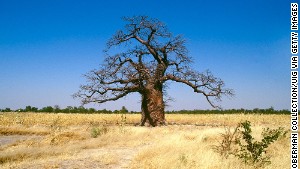
Stately and stoic -- baobabs are Africa\'s oldest and largest trees.
Stately and stoic -- baobabs are Africa's oldest and largest trees.
10. You can have a drink inside a tree
Africa's biggest and oldest trees, baobabs, are found in one of South Africa's driest regions, Limpopo province.
Also known as cream of tartar trees, monkey-bread trees and upside-down trees, kids know them from the "Madagascar" films.
The pulp from the tree contains citric and tartaric acids used as common baking ingredients.
The seeds can be roasted and turned into oil and the fruit is used to make a lemonade-type drink.
Limpopo province is home to a hauntingly beautiful forest of the trees near the border of Zimbabwe. The tree that locals claim is the largest baobab in the world is in nearby Modjadjiskloof.

Standing at 22 meters high and 47 meters in diameter, the center is hollow and has been turned into a bar.


cnn